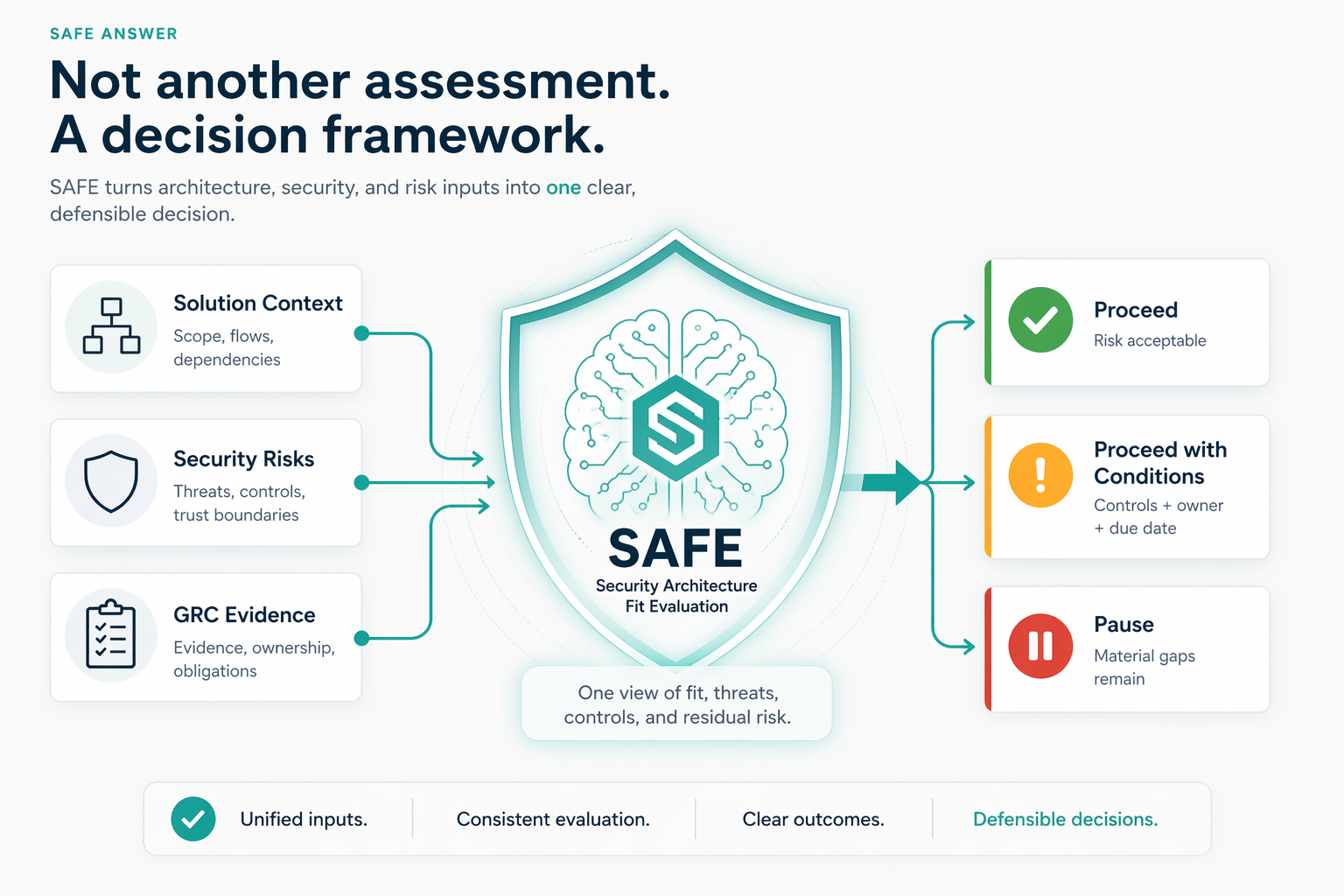
Security Architecture Fit Evaluation

Make security architecture decisions before risk becomes expensive.

SAFE helps leaders decide: proceed, proceed with conditions, or pause before new SaaS, AI, cloud, or vendor risk becomes costly to reverse.

Decision outcomes Proceed Proceed with Conditions Pause

One decision path across architecture, security, GRC, evidence, and business risk.

Threat landscape

Security needs to be proactive because the threat model has changed.

Ransomware and extortion actors increasingly use data theft, identity compromise, SaaS/cloud exposure, and third-party access as leverage. Architecture decisions made today become tomorrow's breach paths if they are not reviewed early.
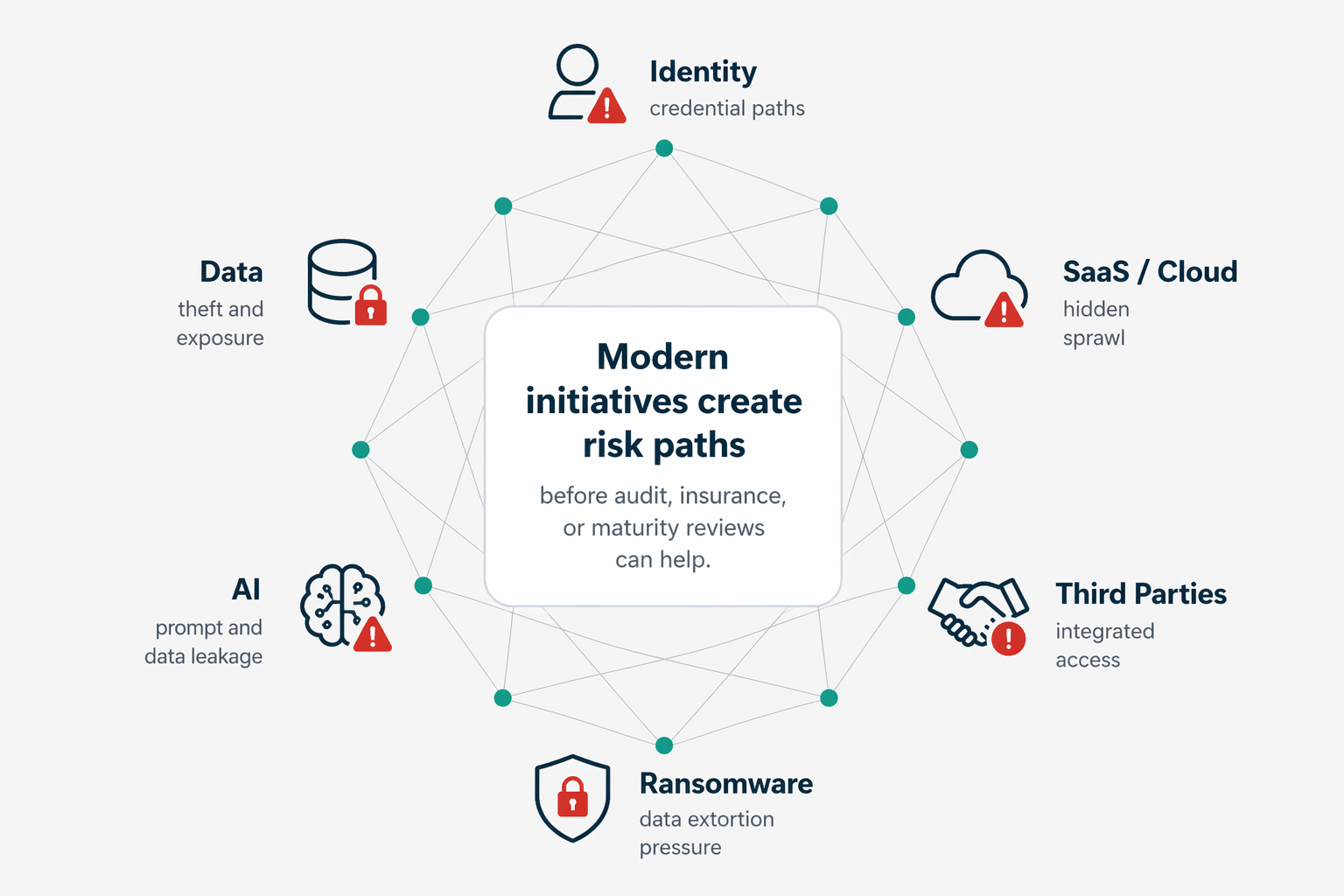
IdentityCredential and privilege paths
DataTheft before disruption
SaaS / CloudHidden exposure and sprawl
AIPrompt, data, and model leakage
ExtortionBusiness pressure before recovery
Threat-led architecture map showing identity, data, SaaS and cloud, third parties, AI, and ransomware exposure
The enterprise gap

Architecture, security, and risk rarely come together as one clear path.

Solution architects move fast, security teams focus on critical projects, and GRC teams face review backlogs. SAFE was built to close the gaps before delivery risk grows.
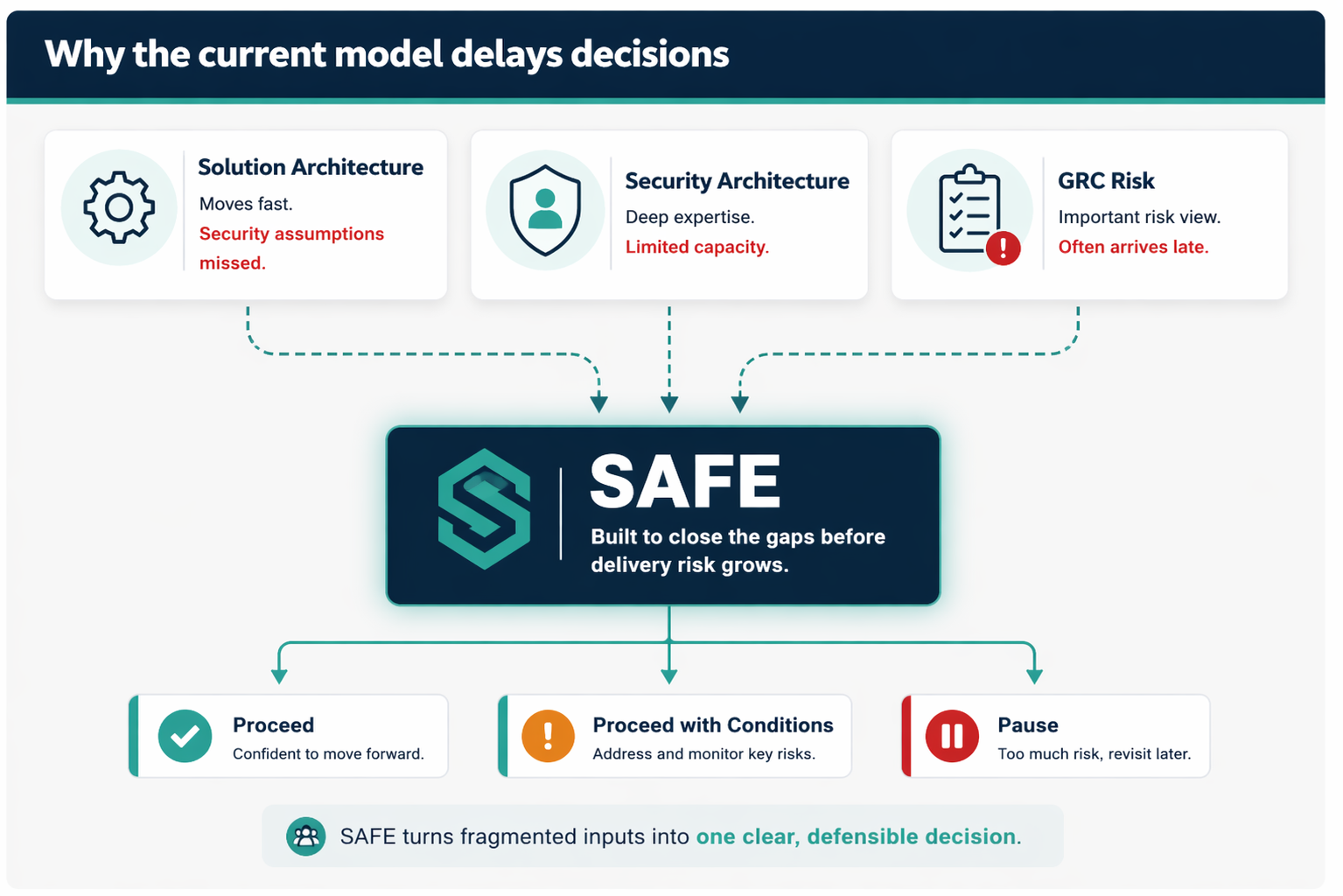
Fragmented review model showing solution architecture, security architecture, and GRC risk inputs converging into SAFE decision outcomes
SAFE answer

Not another assessment. A decision framework.

SAFE converts architecture, security, and risk complexity into a defensible decision path.

SAFE decision model turning solution context, security risks, and GRC evidence into proceed, proceed with conditions, or pause outcomes
Not another assessment

SAFE answers a different question.

Audit, insurance, and maturity reviews all matter. SAFE focuses on the decision in front of the business: Are we safe enough to proceed?

AuditCan we evidence controls?
Cyber InsuranceWill underwriting approve us?
MaturityHow mature is the program?
SAFEAre we safe enough to proceed?
Delivery model

Clear decisions in 2-3 weeks

When stakeholders are responsive and core materials are available.

1
Week 1

Intake & Architecture Review

  • Scope and objectives
  • Stakeholders
  • Data flows
  • Integrations
2
Week 2

Threat & Control Evaluation

  • Threat model
  • Control fit
  • Risk scoring
  • Draft findings
3
Week 3

Decision Readout

  • Proceed / Conditional / Pause
  • Conditions & owners
  • Executive summary
  • Action roadmap
1 FrameworkUnified methodology
3 WeeksFocused decision cycle
1 Decision PathClear, defensible outcomes
Executive ReadyBuilt for leadership
Engagement paths

From architecture decision to control validation.

Engagements are scoped based on architecture complexity, integrations, data sensitivity, stakeholder availability, and evidence depth. Z1 provides fixed-fee options after scoping.

SAFE

A 2-3 week decision framework for scoped technology changes, SaaS onboarding, AI tools, cloud changes, and vendor integrations.

Best when the initiative is bounded and leaders need a fast proceed, conditional, or pause decision.

Explore SAFE
SAFE+

A premium SAFE review for high-impact initiatives involving multiple integrations, sensitive data, complex identity flows, or executive-level risk decisions.

Best for PII, PCI, PHI, HR, financial, client-confidential, AI, cloud, or multi-system environments.

Explore SAFE+
SAFE Validate

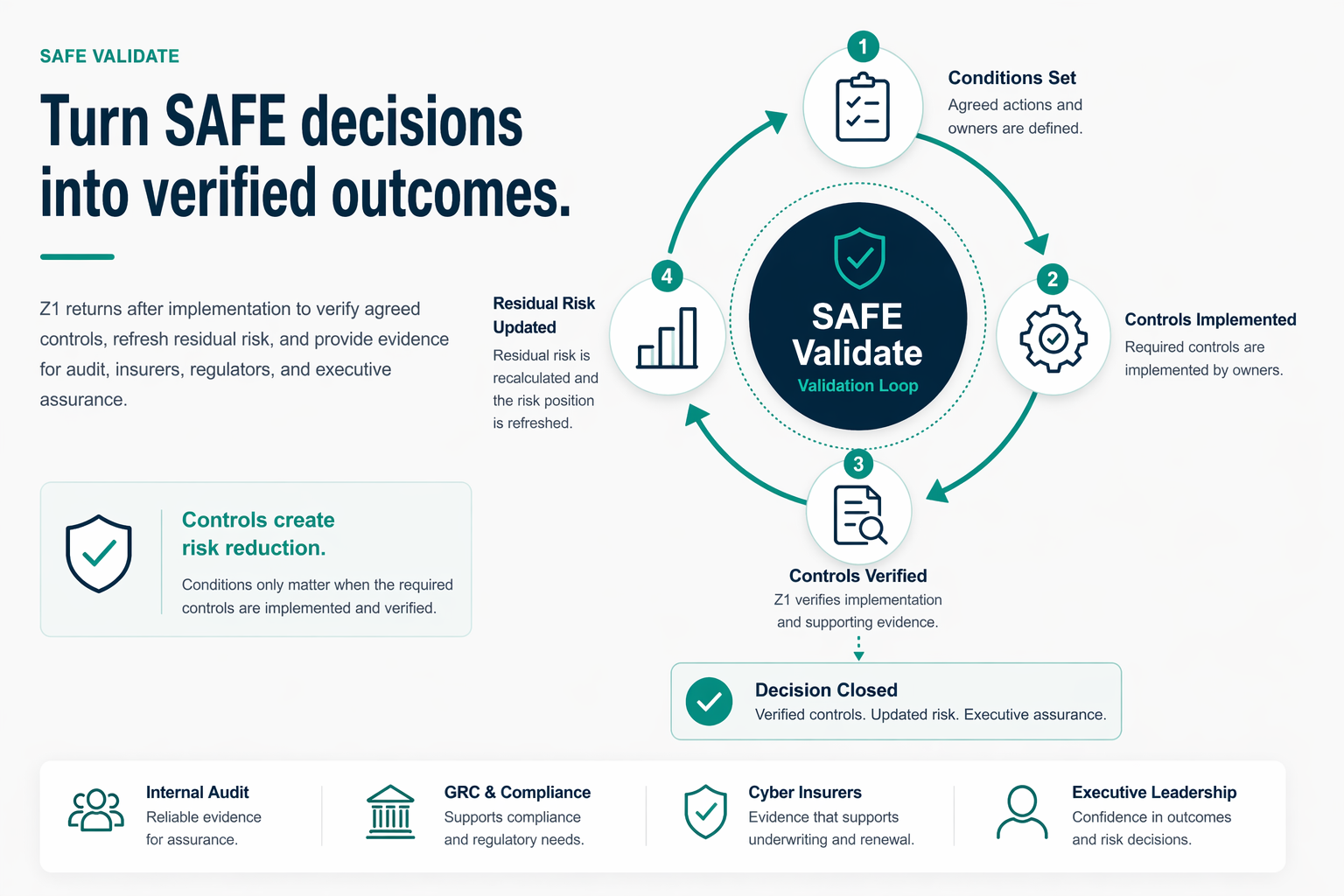
The follow-through review that turns SAFE conditions into evidence, closure status, and an updated risk position.

Useful for internal audit, GRC, cyber insurers, external assessors, and executive assurance.

Explore Validate
SAFE Retainer

Ongoing security architecture decision support for organizations with continuous technology change.

Useful when new tools, integrations, vendors, cloud changes, and AI use cases keep arriving.

Discuss Retainer
Security Patterns

Reusable security architecture patterns and control baselines that help teams make faster, more consistent design decisions.

Useful for repeatable SaaS, identity, data, AI, cloud, and vendor patterns.

Discuss Patterns
SAFE Validate

Controls only count when they are implemented and proven.

Z1 can return after implementation to verify agreed controls, refresh residual risk, and produce evidence useful for audit, insurers, regulators, and executive assurance.

SAFE Validate loop from conditions set to controls implemented, controls verified, residual risk updated, and decision closed
Where SAFE fits

Use SAFE before the business gets locked into a risky path.

SaaS onboarding, AI tools, cloud changes, vendor integrations, data platforms, identity changes, and executive decision gates.

Discuss My Initiative